
For years, the premium playbook was fairly easy to recognize: better ingredients, elevated materials, refined design, a higher price point. Consumers understood the signal. But that equation is getting harder to rely on.
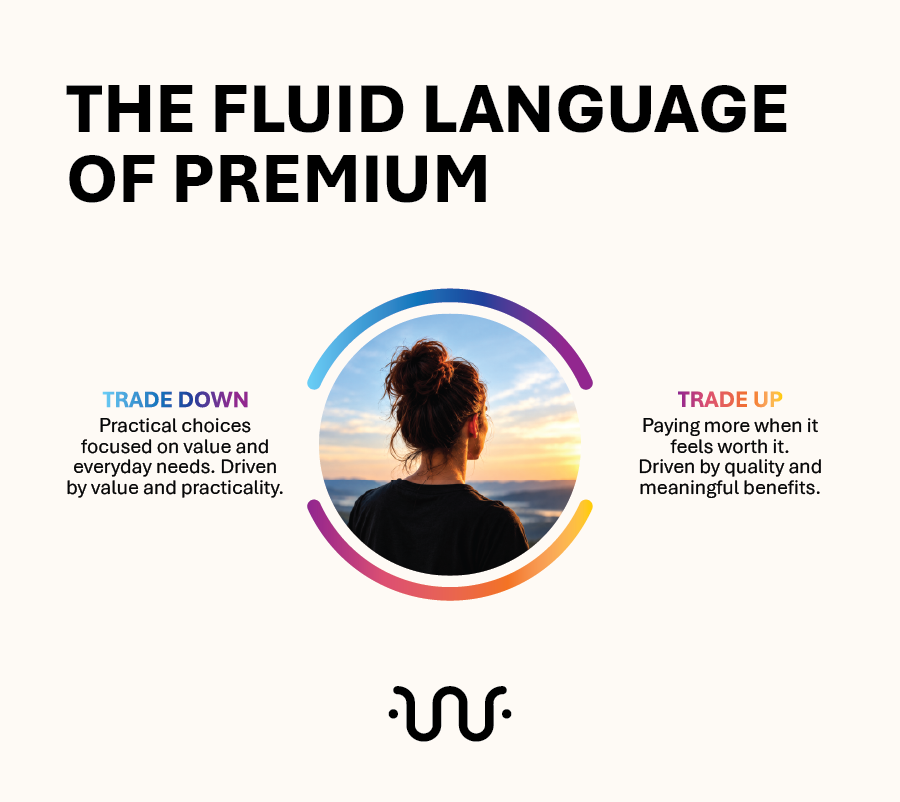
Economic pressure is part of the reason, but the more interesting shift is behavioral. Consumers are increasingly moving between two purchasing mindsets rather than behaving as fixed “premium” or “value” shoppers. They move into an upgrade mindset when a product earns its higher price through relevance, performance, convenience, or trust, and trade down when that value isn't clear.
A willingness to trade up doesn't mean a willingness to spend indiscriminately. 60% of consumers in an “upgrade mindset” say they focus on value for money, while 46% are willing to pay more for convenience.¹ Price-constrained consumers aren't simply buying whatever is cheapest either. They will selectively pay more when the benefit makes the decision easy to defend. So perhaps the more useful question for brands isn't simply: How do we make this look more premium? It's what makes this worth more to this consumer, in this category, at this particular moment?
Premium and value are no longer sitting at opposite ends of the spectrum. In a GlobalData study, consumers ranked high-quality products or ingredients above low price as a marker of “good value for money” in eight out of ten food and beverage categories.² Paying more can still feel like good value when consumers can see, understand, or experience what makes it worth more.
What counts as “better” has become more complicated. It might mean craftsmanship and provenance in one category, better performance or convenience in another, or simply an indulgence that feels worth protecting. These motivations aren't neatly divided by income either. Many middle-income consumers selectively trade up for products that feel special, safe, or personally relevant.² The same person can be intensely price-conscious in one aisle and happily trade up in another. The consumer hasn't necessarily split. The consumer has become more fluid.
That fluidity is changing the premium equation. Premium is becoming less about adhering to a recognizable aesthetic and more about making a specific kind of value tangible. Traditional cues still have a role: beautiful materials, restrained typography, craftsmanship, and distinctive structures can establish perceptions of quality before someone ever experiences the product. But they are no longer the whole vocabulary. Premium can be sensorial and indulgent, or even clinical and precise. In health-oriented categories, measurable benefits can matter more than indulgence.² In food, the equation shifts, with superior ingredients, craftsmanship, provenance and distinctive sensory experiences providing different reasons to pay more.²
Premium can also signal identity rather than simply wealth. 55% of Millennials say they would pay more for a personalized product or service, compared with 28% of Baby Boomers, reflecting younger consumers' stronger interest in individuality and personal relevance.² The expression of that value can vary widely. Purity, material transparency, and reduced excess can communicate intentionality. Playful, collectible, or display-worthy design can create value through self-expression and identity.
These expressions look different because they are solving different value equations.
For packaging teams, this is where the opportunity gets interesting. The answer isn't to replace one premium aesthetic with another.
It is to understand where consumers are willing to trade up, what gives them permission to do it, and how packaging can make that value tangible. Sometimes that may even mean a smaller pack, concentrated format, or accessible indulgence that lowers the cost of entry rather than pushing the price ceiling higher.
At WovenWorks, we unite every strand of the packaging journey, from insights and strategy to structure, graphics, engineering, testing, and production, into one seamless process. We believe iconic brands aren't assembled from parts. They're woven with precision, purpose and vision.
That integrated approach helps us uncover where value really lives and translate it into packaging people can see, feel and experience. When the definition of premium is fluid, the opportunity isn't simply to design something that looks more expensive. It's to understand what worth more means to the consumer, in the category and occasion that matters, and then make that value impossible to miss.
Premium hasn't disappeared. What has disappeared is the assumption that premium means the same thing to everyone. Premium isn't a look. It's a reason to choose.
1. A Tale of TwoConsumers: The polarized mindsets reshaping global consumption, NielsenIQ, 2026
2. TrendSightsAnalysis 2025: Premiumization & Indulgence, GlobalData, September 25, 2025
